📘 Full Movie At The Bottom 👇👇
The first crack sounded like a bone breaking beneath the world.
Every villager kneeling in the cavern flinched at once. Chains rattled. Torches guttered. Somewhere far below the black stone floor, something ancient answered with a growl so deep it seemed to rise through their blood before it reached their ears.
High Priest Veyran froze with the iron hammer still raised above his head.
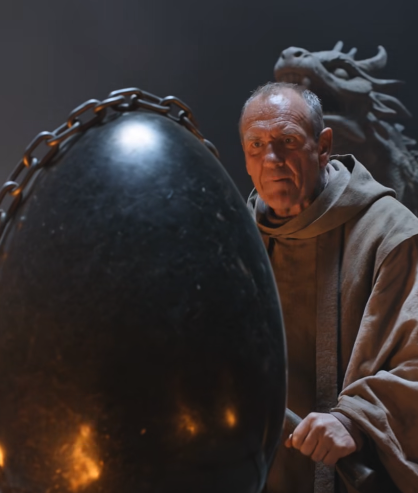
On the obsidian altar before him, the sacred black egg—worshiped, feared, guarded, and lied about for seven hundred years—split open beneath a river of molten gold light.
No one screamed at first.
They were too terrified to breathe.
The egg had been taller than a man, smooth as polished night, veined with silver lines that pulsed faintly like sleeping lightning. For centuries, it had rested beneath the Ancient Dragon Temple, buried under the volcanic mountains of Ashkar, where the air tasted of sulfur and old prayers. The priests had told the kingdom it was a dead relic, the last corpse of the dragon gods, a reminder of why humans must never trust beasts of fire again.
Tonight, they had brought the villagers here to witness its destruction.
Tonight, the kingdom was meant to be freed from fear.
Instead, the shell fell away.
And inside was a child.
Small. Barely six years old, perhaps younger. Curled against the broken inner shell as if still dreaming. Dark hair clung to the child’s forehead. Golden markings glowed beneath warm brown skin, delicate and alive, flowing from the throat to the wrists like rivers of sunlight. Around the child’s shoulders and spine, black dragon scales folded like armor, not monstrous, not cruel, but protective—almost tender.
The High Priest lowered the hammer by an inch.
“No,” he whispered.
The child stirred.
A woman in the front row choked back a sob. Her name was Mara, a potter from the lower village, dragged from her home at dusk with the rest of the villagers because the priests wanted witnesses. She had lost her own son to temple soldiers three winters ago when he asked why dragon statues were smashed every year at the Festival of Ash. Since then, she had learned the safest prayer was silence.
But when she saw the child in the egg, something inside her cracked wider than the shell.
“That’s not a demon,” she breathed.
Priest Veyran heard her.
His face, old and sharp as carved bone, twisted with panic.
“Silence.”
The child opened their eyes.
They were gold.
Not human gold. Not torchlight gold. Dragon gold—vertical pupils glowing with the memory of stars. The child looked first at the hammer, then at the chains, then at the kneeling villagers. Their gaze stopped on Mara.
For one heartbeat, the cavern became impossibly still.
Then the floor growled again.
This time, stones fell from the ceiling.
The priests stumbled backward. Temple guards raised spears with shaking hands. The villagers began to cry out, pressing their foreheads to the ground.
High Priest Veyran lifted the hammer again.
“Kill it!” he shouted. “Before it wakes the buried one!”
A guard lunged.
Mara moved before thought could stop her.
She sprang up from the kneeling crowd and threw herself between the spear and the altar. The spearhead sliced across her shoulder. Pain exploded white-hot through her body, but she did not fall. She grabbed the child from the broken egg and clutched them against her chest.
The child was warm.
Not burning. Warm.
Like bread fresh from an oven. Like a sleeping bird. Like life.
“Run!” someone shouted.
Chaos broke open.
Villagers surged against chains. Guards struck with spear shafts. Priests screamed prayers that sounded suddenly like threats. The temple trembled as if something beneath it was trying to remember how to stand.
Mara ran.
She had not run since her son died. Grief had made her slow, careful, obedient. But with the dragon child in her arms, she ran as if every lost thing in the world had been returned to her and might be stolen again.
Behind her, Veyran’s voice echoed through the cavern.
“Seal the mountain! No one leaves with that creature!”
The child pressed a small hand against Mara’s bleeding shoulder.
The pain vanished.
Mara almost stumbled.
She looked down.
The golden marks beneath the child’s skin pulsed softly, and her wound closed beneath torn cloth.
The child’s voice came out fragile, unused.
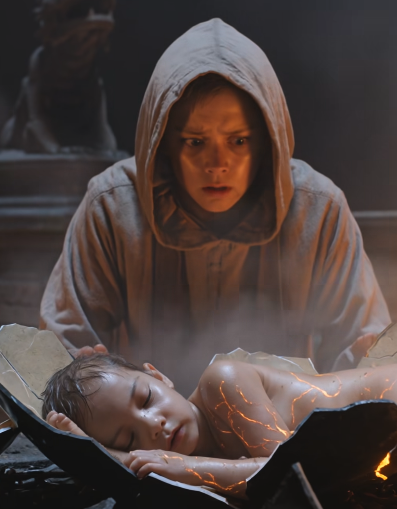
“Are you… my mother?”
Mara’s heart broke so violently she nearly stopped running.
“No, little one,” she whispered. “But I can be brave until we find her.”
The child nodded, as if this answer made perfect sense.
“My name is Aurel.”
Mara held them tighter.
“Then hold on, Aurel.”
They fled through the lower tunnels while the mountain shook above them. Mara knew the old paths because her husband had once worked as a stone mason before temple taxes killed him more slowly than any blade. She remembered stories of hidden vents, abandoned wells, tunnels carved before the priests claimed the mountain.
Behind them came boots.
Ahead, darkness.
Aurel lifted one tiny hand.
Gold light bloomed from their palm, illuminating carvings on the tunnel walls.
Mara slowed.
The carvings were not of dragons burning cities, as temple murals showed.
They were of dragons carrying children on their backs through storms. Dragons sheltering harvest fields beneath wings. Dragons bowing beside human kings. Dragons and humans building the first temple together.
Mara stared.
“All my life,” she whispered, “they told us dragons destroyed the old kingdom.”
Aurel touched the wall.
The stone answered.
A memory flashed through the tunnel like lightning trapped in glass.
A woman with golden eyes stood before a black dragon, one hand on its snout, tears shining on her face. Around them, priests in white robes raised knives. A baby cried inside a black egg.
Mara staggered backward.
Aurel began to tremble.
“The egg wasn’t a prison,” the child whispered. “It was a cradle.”
Before Mara could answer, soldiers burst around the corner.
“There!”
Mara grabbed Aurel’s hand and ran again, but the tunnel ended at a broken bridge over a river of lava. Heat roared upward. The opposite ledge was too far.
The guards closed in behind them.
Mara placed Aurel behind her.
“I won’t let them take you.”
Aurel looked at the lava. Then at Mara.
“I think,” the child said softly, “someone is waiting for me.”
They stepped forward.
“Aurel, no!”
But the lava did not burn them.
It rose.
Molten fire lifted like a golden serpent, forming a bridge beneath the child’s bare feet. Mara crossed with her heart hammering against her ribs. The guards tried to follow, but the bridge collapsed into sparks the moment Mara reached the other side.
From far below, the growl became a voice.
Not words.
A name.
Aurel.
The child fell to their knees.
“I know that sound.”
Mara knelt beside them. “What is it?”
Aurel looked toward the depths beneath the mountain.
“My father.”
The truth reached the capital before dawn, but twisted.
By morning, bells rang across the kingdom.
By noon, criers stood in every square declaring that a dragon demon had hatched beneath Ashkar and bewitched villagers. By sunset, King Ordan himself ordered the mountain surrounded.
But the king was afraid.
Not of dragons.
Of memory.
For seven hundred years, the royal house had ruled by one sacred story: dragons betrayed mankind, burned the old world, and were destroyed by the first priest-king. Every child learned it. Every festival repeated it. Every temple statue showed humans victorious over beasts.
But beneath the mountain, Mara and Aurel found another history.
They descended deeper than any priest had dared go. The lower caverns were vast, glowing with blue crystals and rivers of underground fire. Ancient doors opened for Aurel. Murals awakened beneath their hands. Each chamber revealed pieces of the lie.
Dragons had not betrayed humans.
Humans had betrayed dragons.
The first priest-king had feared their power. He could not rule a kingdom where dragons answered love instead of crowns. So he murdered the dragon riders, shattered the bond between species, and trapped the last dragon king beneath the temple. The egg had held Aurel, child of the final dragon queen and a human healer who had tried to save the bloodline.
The egg had slept because the kingdom had forgotten its promise.
And now, because the priests tried to destroy it, Aurel had awakened.
Mara listened to each revelation with grief turning slowly into fire.
“My son asked questions,” she said. “That’s why they took him.”
Aurel touched her hand.
“What was his name?”
“Eli.”
The child closed their eyes.
Golden light shimmered.
And suddenly Mara heard laughter.
A boy’s laughter.
She saw Eli, not as he had been in death, but running through sunlight with soot on his cheeks and a wooden dragon toy in his hand.
Mara covered her mouth.
“He isn’t here,” Aurel said gently. “But love leaves echoes. Dragons can hear them.”
Mara wept then—not quietly, not politely, but with the full broken sound of a mother who had been forced to swallow grief for years.
Aurel leaned against her.
“I’m sorry they made you lonely.”
Mara wrapped both arms around the child.
“I’m sorry they made you sleep alone.”
Above them, war gathered.
The king arrived at Ashkar in black armor, surrounded by priests and soldiers. High Priest Veyran stood beside him, pale and furious, clutching the cracked iron hammer like a holy relic.
“You said the egg was dead,” King Ordan hissed.
“It should have been.”
“Should have been?”
Veyran’s jaw tightened. “The old blood was stronger than expected.”
The king looked toward the sealed temple gates.
“If the people see it, the throne falls.”
“If the dragon beneath wakes,” Veyran replied, “there will be no throne left to fall.”
The king’s eyes hardened.
“Then bury the mountain.”
By night, soldiers packed explosive firepowder around the temple foundations. Villagers from nearby settlements were dragged away at spearpoint. Anyone who resisted was chained.
Mara and Aurel emerged into the central cavern just as the first blast shook the mountain.
The obsidian altar split.
The floor opened.
And beneath it, something enormous moved.
A black dragon rose from the abyss.
Not in rage.
In agony.
Chains as thick as towers bound his wings, neck, and claws. Spears of white stone pierced his sides, each carved with priestly runes. His scales were dull from centuries of darkness, but his eyes—his eyes were the same gold as Aurel’s.
The child stepped forward, shaking.
“Father?”
The dragon lowered his massive head.
The cavern filled with his breath, hot and trembling.
“My little dawn,” he said.
Mara sank to her knees.
Not from fear.
From awe.
Aurel ran to him. The dragon pressed his snout gently to the child, and golden light burst between them. The mountain stopped shaking for one perfect moment.
Then Veyran entered with soldiers.
“So,” he said, voice echoing. “The beast still speaks.”
The dragon’s eyes narrowed.
“Veyran.”
Mara’s blood chilled.
The High Priest smiled.
“You remember me.”
Aurel turned. “You know him?”
The dragon’s voice lowered into thunder.
“He was there when your mother died.”
Veyran did not deny it.
“She chose monsters over mankind.”
“No,” Mara said, rising. “She chose truth over power.”
The priest looked at her as if noticing dirt on his robe.
“You know nothing, potter.”
“I know enough.”
Veyran lifted the hammer. Its iron head glowed with white runes.
Aurel gasped.
Mara saw fear flash across the child’s face.
Not fear for themselves.
Fear for the dragon.
“That hammer,” Aurel whispered. “It made the chains.”
Veyran smiled.
“And it will finish what mercy failed to do.”
He struck the ground.
White fire raced across the cavern. The dragon roared as the chains tightened, tearing into ancient wounds. Aurel screamed and collapsed, golden markings flickering.
Mara ran toward Veyran, but guards seized her.
The priest walked to the child.
“This is what truth brings,” he said. “Pain. War. Chaos. Lies are kinder.”
Aurel looked up, trembling.
“No,” the child whispered. “Lies are cages.”
Veyran raised the hammer.
Mara fought like a wild thing.
And then she saw it.
The hammer’s handle was not iron.
It was bone.
Dragon bone.
Carved into it was the same small symbol she had seen in the murals: a spiral sun, the mark of Aurel’s mother.
Mara understood.
The weapon had not been made only to chain dragons.
It had been stolen from the queen who tried to save them.
“Your mother’s mark!” Mara shouted. “Aurel, the hammer remembers her!”
Veyran turned too late.
Aurel reached out.
The spiral sun on the hammer ignited.
Veyran screamed as gold light burned through the white runes. The hammer flew from his hands and landed before Aurel. The child touched it.
The cavern filled with a woman’s voice.
“My child, when the world calls you monster, remember this: fire does not only destroy. It reveals what darkness tried to hide.”
The hammer shattered.
The chains broke.
The dragon rose.
For a moment, everyone believed destruction had come.
The soldiers dropped their weapons. Priests fell to the floor. Veyran crawled backward, suddenly small.
The dragon spread his wings, vast enough to cover the cavern ceiling.
But he did not burn them.
He bent his head to Aurel.
“What do you command, little dawn?”
Aurel looked at Veyran.
The priest trembled. “Kill me, then. Prove what you are.”
Aurel’s eyes glowed brighter.
“No.”
Veyran blinked.
Aurel stepped closer, still small, still barefoot, still wrapped in scales that looked like midnight.
“You wanted everyone afraid of the past,” the child said. “So your punishment is to watch them remember.”
They placed both hands on the broken altar.
Gold light exploded upward through the mountain.
Across the kingdom, every dragon statue cracked open—not breaking, but shedding false stone. Hidden murals appeared beneath temple walls. Burned books restored their missing words. Songs forgotten by grandmothers returned to their tongues. Children woke from dreams of wings and sunlight. Old lies unraveled in every square, every palace hall, every soldier’s barracks.
King Ordan saw the truth reflected in his own throne room floor: his ancestor kneeling before the first dragon, swearing friendship—then later driving a blade into that same dragon’s heart.
The king removed his crown.
At Ashkar, the villagers rose.
Not violently. Not cruelly.
Together.
The guards lowered their spears. Some wept. Some asked forgiveness. Mara looked at them and thought of Eli, of all the children taught to fear wonder, all the mothers taught to bury questions.
Veyran was taken away in chains, not by soldiers, but by the very villagers he had forced to kneel.
The mountain opened at dawn.
For the first time in seven centuries, a dragon stepped into sunlight.
He was wounded. Scarred. Half-starved by time.
But alive.
Aurel sat between his horns, one hand resting against his scales, the other reaching down for Mara.
“Come with us,” the child said.
Mara looked back at the villagers, at the temple, at the broken altar.
“I’m only a potter.”
Aurel smiled.
“You were the first one who saw me.”
The dragon lowered his wing like a bridge.
Mara climbed.
When they flew over the kingdom, people did not run.
Some knelt. Some cried. Some lifted their children so they could see. Bells rang again, but this time not as alarms. As welcome.
In the capital, King Ordan met them without armor.
He bowed before Aurel, Mara, and the dragon.
“My crown was built on a lie,” he said. “Tell me how to make truth stronger than fear.”
Mara expected Aurel to answer like a god.
Instead, the child reached for her hand.
So Mara, a potter with a healed shoulder and a heart still full of grief, spoke for all the kneeling villagers.
“Start,” she said, “by never forcing anyone to kneel again.”
Years later, the Ancient Dragon Temple became something else.
Not a place of sacrifice.
A school.
Children learned both histories there: the lie that ruled a kingdom, and the truth that saved it. They learned that fear can wear holy robes. They learned that power often destroys what it cannot control. They learned that dragons were not gods, and humans were not helpless, and peace was not born from forgetting pain but from facing it together.
Mara became keeper of the first kiln of Ashkar, where black clay from the volcanic mountain was shaped into small dragon figurines. Every child received one when they learned to read the restored histories.
Aurel grew slowly, strangely, beautifully—part child, part dragon, wholly themselves. Sometimes their golden eyes looked ancient. Sometimes they laughed with jam on their chin. Sometimes they slept curled beside Mara’s hearth, wrapped in a blanket because scales, they insisted, did not mean they never got cold.
And the great black dragon slept above the temple, no longer chained beneath it, his wings folded around the mountain like a promise.
On the anniversary of the hatching, Aurel placed a small clay dragon beside Mara’s old wooden toy—the one that had belonged to Eli.
“Do you think he would have liked me?” Aurel asked.
Mara smiled through tears.
“He would have asked you a thousand questions.”
Aurel grinned.
“I would have answered every one.”
Far below them, the mountain gave a soft, contented rumble.
Not a warning.
Not a threat.
A heartbeat.
And for the first time in seven hundred years, the kingdom did not mistake it for a monster.
