📘 Full Movie At The Bottom 👇👇
The first kingdom vanished on a Tuesday.
Not burned. Not conquered. Not buried beneath armies.
Vanished.
By dawn, the fortress city of Vaelor stood empty beneath a sky bruised purple with thunder. Swords lay in the mud. Horses trembled in their stalls. Supper still steamed on abandoned tables. Ten thousand soldiers, three hundred officers, and King Malrec the Iron-Blooded were simply gone.
No bodies.
No footprints.
Only rain.
By the third disappearance, villages stopped ringing warning bells when enemy banners appeared on the horizon. Bells were for armies. Bells were for fires. Bells were for things human hands could understand.
Now people watched the clouds.
Because somewhere beyond the northern mountains, a silent child was walking.
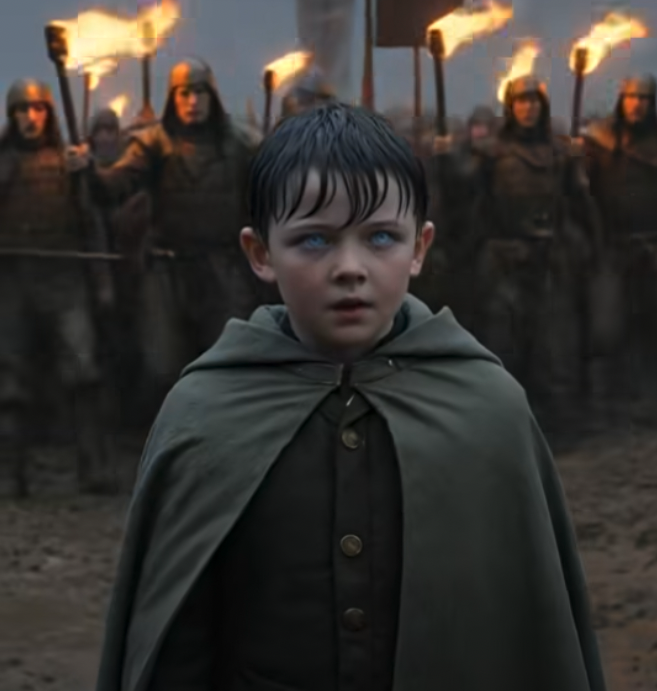
He was said to be nine years old, though no one knew for certain. Thin as winter branches. Barefoot. Dark hair plastered to his face by rain that followed him even under clear skies.
The soldiers called him Sky’s Wrath.
The peasants called him mercy.
The kings called him impossible.
And the boy called himself nothing at all.
His real name was Erian.
He had not spoken in four years.
Not since the night men wearing royal gold dragged his mother from their cottage and nailed the door shut behind them.
Not since the crown decided a prophecy was cheaper to kill than understand.
Erian remembered the smell of smoke more than the screaming. He remembered his mother’s palm against his cheek.
“Do not hate the sky,” she whispered, though thunder shook the roof. “It only answers what the heart cannot hold.”
Then she pushed him through the cellar hatch.
By morning, his village was ash.
By night, the first storm came for the soldiers.
Years later, Queen Seraphine of Ardenthal stood before her war council while rain clawed against the palace windows.
“Enough,” she said. “Find the child.”
General Daven laughed once, sharp and ugly. “Your Majesty, with respect, we are fighting three invading kingdoms. We do not have time to chase nursery tales.”
The queen turned slowly.
Daven stopped smiling.
“Three invading kingdoms,” she said, “have each lost battalions without a battle. If that is a nursery tale, General, then I suggest you start fearing children.”
At the far end of the table, Prince Cael said nothing.
He was sixteen, old enough to wear a sword, young enough to still feel shame. His father had been king before Seraphine took the throne. His father had signed the decree that destroyed Erian’s village.
Cael had found the order years later in a sealed archive.
Burn the settlement. Eliminate the storm-born child. Leave no witnesses.
His father’s signature.
His family’s seal.
His blood.
That night, Cael entered the old chapel beneath the palace, where forbidden records slept under dust. Queen Seraphine was already there.
“You know,” she said.
Cael swallowed. “The boy is not attacking kingdoms. He is attacking crowns.”
“No,” Seraphine whispered. “He is answering them.”
Before Cael could ask what she meant, thunder rolled so deeply the chapel candles died.
In the darkness, a child’s voice spoke for the first time in four years.
“Then let them answer me.”
The storm broke over Ardenthal before dawn.
Not with lightning.
With silence.
Every soldier in the outer camps woke unable to move. Rain hovered in the air around them, each drop suspended like glass. Horses knelt. Banners sagged. Fires burned blue.
And through the frozen rain walked a barefoot boy.
Erian entered the palace courtyard alone.
Archers raised their bows from the walls. Their strings snapped before arrows could fly.
General Daven drew his sword. The blade rusted to dust in his hand.
Queen Seraphine descended the steps without guards.
The court gasped.
Cael ran after her. “Aunt, no!”
But Seraphine kept walking until she stood before the child.
Erian’s eyes were gray, not like clouds, but like the space after lightning strikes.
“You wear a crown,” he said.
His voice was small.
That made it worse.
Seraphine removed the crown from her head and placed it on the wet stones between them.
“Yes,” she said. “And it is heavier than it looks.”
Erian stared at her.
Behind him, thunder gathered like an army.
“My mother begged,” he said.
Seraphine closed her eyes. “I know.”
“My village burned.”
“I know.”
“They called me a danger.”
“You were a child.”
His face twisted then—not with rage, but with grief so old it had become weather.
“Then why did no one come?”
The question struck harder than lightning.
No one answered.
Not the nobles watching from balconies. Not the generals. Not Cael, whose throat burned with inherited guilt.
Seraphine knelt.
The court cried out again, but she ignored them.
“Because cowards often sit higher than the innocent,” she said. “Because crowns teach people to obey before they teach them to think. Because your mother was right, and we were afraid.”
Erian trembled.
The rain began falling upward.
Cael stepped forward, heart pounding.
“My father signed the order,” he said.
Erian looked at him.
Cael forced himself not to look away. “He is dead. That does not repay you. Nothing repays you. But I carry his name, and I won’t hide behind his grave.”
“Do you want forgiveness?” Erian asked.
“No,” Cael said. “I want to give you the truth.”
He pulled a sealed parchment from his coat and laid it beside the crown.
“The order was not to kill you because you would destroy kingdoms,” Cael said. “It was because you would reveal what crowns truly are.”
Erian stared.
Seraphine’s face went pale. “Cael…”
But the prince continued.
“There was a prophecy,” he said. “Not that you were born to bring storms. That was the lie. The prophecy said: When the sky-born child weeps before a crown, every oath sworn falsely beneath it will be unmade.”
The nobles froze.
Across the courtyard, several ministers slowly backed away.
Erian’s gaze shifted from Cael to Seraphine.
“What does that mean?”
“It means,” Seraphine whispered, “you were never the weapon.”
The suspended rain began to glow.
“You were the judgment.”
Then the sky opened.
Not above them.
Inside them.
Every lie ever sworn beneath the Ardenthal crown tore loose.
Nobles screamed as jewels blackened around their throats. Generals collapsed, vomiting smoke. Hidden murders spilled from mouths. Stolen lands. Poisoned heirs. Sold children. Wars begun for mines and dressed up as honor.
The court became a storm of confession.
Erian staggered backward, horrified.
“No,” he whispered. “I didn’t—”
Cael caught him before he fell.
The boy was burning cold.
“I don’t want this,” Erian said, shaking. “I don’t want to make people disappear.”
Cael looked toward the empty crown.
Then at his aunt.
Seraphine understood.
The shocking truth settled over them all.
The vanished kingdoms had not been destroyed by Erian.
Their own false oaths had unmade them.
The boy had only walked near enough for the sky to listen.
Seraphine rose and faced the screaming court.
“Then let this be the last crown,” she said.
She lifted the golden circlet.
For one breath, every person in the courtyard watched.
Then Queen Seraphine broke the crown across her knee.
The sound was small.
The storm’s answer was not.
Light burst through the rain. Chains of old magic snapped above the palace, invisible until the moment they died. Across the kingdom, every throne room shook. Every royal banner split down the center. Every prison door holding the innocent opened.
And Erian screamed—not in pain, but because every storm he had carried since childhood finally left his body.
Cael held him as the boy collapsed.
For the first time in four years, the rain stopped.
When Erian woke, he was in a sunlit room with white curtains moving in a warm breeze.
No thunder.
No chains.
No crown.
Cael sat asleep in a chair beside him, one hand still wrapped around Erian’s sleeve as if afraid the world might take him again.
At the window stood Seraphine, no longer queen.
She turned when the bed creaked.
“The invading armies have surrendered,” she said softly. “Most were conscripts. They’re going home.”
Erian touched his throat. “And the kings?”
“Those who ruled falsely are gone. Those who remain have begun breaking their crowns.”
He looked frightened by that.
“I didn’t mean to erase them.”
Seraphine crossed the room and knelt beside the bed, as she had in the courtyard.
“No,” she said. “They erased themselves long before you arrived.”
Erian’s eyes filled.
“My mother said the sky answers what the heart cannot hold.”
Cael woke then, blinking.
Erian looked at him. “What happens to me now?”
Cael smiled tiredly. “Breakfast, I hope. You look like you could defeat three kingdoms but not a bowl of porridge.”
For a moment, Erian only stared.
Then he laughed.
It was small. Rusty. Almost broken.
But it was laughter.
Outside, people gathered in the streets—not to cheer a ruler, but to read the new decree nailed to the palace gates.
No throne would rise again in Ardenthal.
No child would be killed for prophecy.
No village would burn because powerful men feared the future.
And in the palace garden, where rainwater still glittered on the leaves, Erian planted a single seed from the ashes of his old home.
Years later, travelers would come from distant lands to see the tree that grew there.
Its leaves shimmered silver before storms.
Its branches bent over children when they cried.
And beneath it, carved into stone, were words no king had ordered and no crown had approved:
The sky was never wrathful. It was grieving.
