📘 Full Movie At The Bottom 👇👇
Part 2
The lock turned once.
Then twice.
My mother-in-law froze.
For the first time in three years, I saw fear move across her face.
Not guilt. Not regret.
Fear.
The front door opened before she could reach it, and my husband stepped inside wearing his work jacket, his face pale and stunned.
Behind him stood our neighbor, Mrs. Alvarez, holding her phone in one hand and a spare key in the other.
I stared at the key, confused through my tears.
My husband’s eyes dropped to me on the stairs.
Then he looked at his mother.
“What did you do?” he asked.
His voice was low, almost too calm.
His mother instantly changed.
Her shoulders slumped. Her eyes filled. Her mouth trembled like she had been the one cornered and terrified.
“She attacked me,” she cried. “I tried to stop her from hurting herself. She went crazy because I asked about dinner.”
I couldn’t even speak.
My husband looked at me, then at the cabinets hanging open, then at the broken bowl on the floor, then back at his mother.
Mrs. Alvarez stepped inside.
“That is not what happened,” she said sharply. “I heard everything from my porch. We all did.”
My mother-in-law’s face twisted.
“You stay out of my family business.”
“No,” Mrs. Alvarez said. “Not this time.”
Sirens wailed in the distance.
My husband rushed to me, but I flinched before I could stop myself. The movement hurt him. I saw it in his eyes.
He knelt a few feet away, careful not to touch me without permission.
“Emma,” he whispered. “I’m here.”
Those words should have comforted me.
Instead, they broke something inside me.
Because he had been “here” for three years.
Here, but silent.
Here, but pleading for patience.
Here, but always asking me to endure one more week.
The police knocked hard on the open door a few minutes later. Two officers entered, and the house that had always felt like a trap suddenly felt exposed. Bright lights from the patrol car washed across the walls. Neighbors stood outside in robes and slippers, whispering behind their hands.
My mother-in-law tried to perform for the officers.
She cried. She clutched her chest. She said I was unstable. She said I hated her. She said young wives these days had no respect for family.
But Mrs. Alvarez handed one officer her phone.
“I recorded the last part,” she said.
My mother-in-law stopped crying.
The officer pressed play.
Her voice filled the room.
“By the time they get inside, nobody will believe you.”
Nobody spoke.
Not even her.
My husband looked like the floor had disappeared beneath him.
The officer turned to me gently and asked if I wanted medical help.
I nodded.
My mother-in-law shouted that everyone was being dramatic, that she was the real victim, that this was her house.
But when they asked her to step outside, she refused.
When they insisted, she screamed.
And when they finally led her away, she looked straight at my husband and said, “You choose her over me, and you are dead to me.”
He didn’t answer.
He only watched as they put her in the back of the patrol car.
Then he turned toward me.
For the first time since our wedding day, I saw him not as her son, not as the man caught between two women, but as someone who had finally reached the edge of his own denial.
He whispered, “I’m so sorry.”
I wanted to believe him.
But sorry did not unlock three years of prison.
Sorry did not erase every meal I swallowed in silence.
Sorry did not undo the way I had learned to make myself smaller in that house.
So I looked at him and said the words I had been too afraid to say for years.
“I’m not staying here tonight.”
He nodded quickly.
“Of course. We’ll go anywhere.”
I shook my head.
“No, Daniel.”
His face changed.
I wiped my cheek with a trembling hand.
“I said I’m not staying here.”
And then, before he could answer, the paramedics guided me out through the front door, past the watching neighbors, past the house where I had lost pieces of myself one quiet day at a time.
I did not look back.
But I felt him watching me.
And for once, I let him stand there wondering whether he had waited too long.
Part 3
I spent that night at the hospital.
Nothing was broken, they told me.
I almost laughed.
Because everything felt broken.
My arms ached. My head pounded. My throat burned from crying. But the deepest pain was quieter than all of that. It sat in my chest like a stone.
Daniel stayed in the waiting room until sunrise.
I knew because every time a nurse opened the curtain, I saw him sitting in the same chair with his elbows on his knees and his hands clasped like he was praying.
He texted me seven times.
I only read the first one.
I should have protected you sooner.
I turned the phone face down.
Mrs. Alvarez came by around eight in the morning with a paper bag from a bakery and a change of clothes.
“I thought you might need these,” she said.
I stared at her, stunned.
She shrugged. “Your husband gave me the apartment key before they took his mother away. He said you probably wouldn’t want him going through your things.”
That detail hurt in a strange way.
Because it was considerate.
Because it was late.
Because I did not know what to do with kindness from him after so much cowardice.
Mrs. Alvarez sat beside my bed and opened the bag.
“You know,” she said, “the first month you moved in, I told my sister something was wrong in that house.”
I looked down.
“I tried to hide it.”
“You did,” she said. “Very well. That is why I kept listening.”
A tear slipped down my cheek.
She reached over and squeezed my hand.
“You don’t have to decide your whole life today. Just decide where you are sleeping tonight.”
That sounded simple enough.
But even that decision felt enormous.
My parents lived four hours away. I hadn’t told them much over the years. I had softened every story, sanded every sharp edge, made Daniel’s mother sound difficult instead of cruel.
I could call them.
I could ask for help.
But shame wrapped around my tongue.
Mrs. Alvarez seemed to understand.
“Shame belongs to the person who did wrong,” she said quietly. “People like her survive by convincing everyone else to carry it.”
I cried then.
Not loudly. Not dramatically.
Just enough for the nurse outside the curtain to pause before walking away.
Later that morning, Daniel finally came in.
He looked older than he had the night before.
His hair was messy. His eyes were red. He held a paper cup of coffee he clearly hadn’t touched.
“Can I sit?” he asked.
I nodded.
He sat near the door, leaving space between us.
“My mother was released this morning,” he said.
The stone in my chest grew heavier.
“She can’t go back to the house right now,” he added quickly. “There’s a temporary protective order. She has to stay with Aunt Carol.”
I stared at him.
“And you?”
“I packed a bag.”
“For where?”
His jaw tightened.
“I booked a motel for two nights.”
I said nothing.
He swallowed. “Emma, I know I failed you.”
I looked at the white blanket covering my lap.
He continued, voice rough.
“I kept telling myself it wasn’t that bad because admitting it was that bad meant admitting I was letting it happen. I thought if I worked more, saved more, stayed calm, kept her from exploding too often, we could survive until we moved. But I made you survive something you never should’ve had to survive.”
That was the first honest thing he had said in years.
Not an excuse.
Not a promise.
A confession.
I looked at him then.
“Why did you come home early?”
He flinched.
“Mrs. Alvarez called me. She said she heard screaming and thought my mother was hurting you. I left work immediately.”
“Would you have believed her if she hadn’t recorded it?”
His face crumpled.
The silence answered before he did.
“I want to say yes,” he whispered. “But I don’t know.”
I nodded slowly.
That hurt more than I expected.
Daniel leaned forward, tears in his eyes.
“I’m done defending her. I’m done living there. I’m done asking you to be patient.”
“Being done now doesn’t erase being quiet then.”
“I know.”
“I don’t know if I can forgive you.”
“I know.”
“I don’t know if I want to stay married.”
His hands went still.
For a moment, he looked like he might beg.
The old Daniel would have. He would have said we had been through too much to quit. He would have asked for time. He would have promised that things would change.
Instead, he nodded.
“I understand.”
I hated that his answer made me cry again.
A nurse entered with discharge papers, and the conversation ended there.
By noon, I was released.
Mrs. Alvarez drove me to her sister’s guest room across town.
Daniel followed in his car but did not come inside.
Before I shut the car door, he said, “I’ll bring anything you need. Or I can stay away. You decide.”
For three years, everyone else had decided everything.
What I ate.
Where I slept.
When I spoke.
What I was allowed to feel.
So even though my voice shook, I answered.
“Stay away for now.”
He nodded.
Then he stepped back.
And I walked into a house that did not smell like fear.
Part 4
The first week away from that house felt unreal.
I kept waking up before dawn, already bracing for footsteps in the hall.
But no one came.
No one knocked on the door demanding to know why I wasn’t making breakfast.
No one opened my mail.
No one commented on my clothes, my cooking, my spending, my family, my body, my tone, my face.
Silence, I discovered, had a sound.
It sounded like freedom.
Mrs. Alvarez’s sister, Ruth, was a retired school librarian with silver curls and a habit of talking to her plants. She did not ask questions unless I invited them. She left tea outside my door. She showed me where extra towels were. She told me I could stay “until the moon got tired of rising,” which was the first thing in days that made me smile.
Daniel texted once each morning.
Not long messages.
Just practical ones.
I dropped your clothes with Ruth.
I spoke with a lawyer about the house.
I found an apartment listing near your office. I won’t apply unless you want to see it.
I answered only when necessary.
On the eighth day, I called my mother.
I had planned the conversation in my head a hundred times.
I would be calm. I would explain. I would not cry.
The moment she said, “Hi, sweetheart,” I broke.
Within four hours, my parents were at Ruth’s door.
My father hugged me so carefully it made me cry harder.
My mother held my face between her hands and whispered, “Why didn’t you tell us?”
I wanted to say because I was embarrassed.
Because I thought marriage meant endurance.
Because every time something happened, Daniel promised it was temporary.
Because his mother convinced me I was dramatic.
Because I didn’t want you to hate my husband.
Instead, I said, “I thought I could handle it.”
My father’s face hardened.
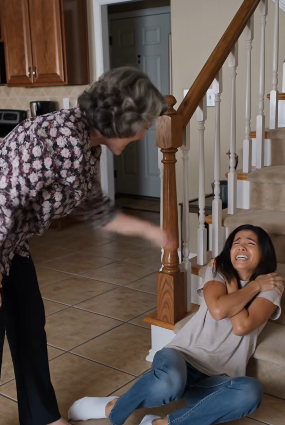
“You should never have had to.”
They wanted me to come home with them immediately.
Part of me wanted that too. I wanted my childhood bedroom, my mother’s soup, my father checking the locks at night. I wanted to be someone’s daughter and nothing else.
But another part of me knew that running straight from one home into another would not answer the question I had been avoiding.
Who was I when no one controlled me?
So I stayed with Ruth.
I went back to work the next Monday. My coworkers pretended not to stare at the fading marks on my arms. My manager quietly told me to take breaks whenever I needed.
At lunch, I found Daniel waiting outside the building.
He stood beside his car, holding a cardboard box.
I almost turned around.
He saw the movement and quickly set the box on the hood.
“I won’t come closer,” he said. “This is just some of your stuff.”
I walked toward him slowly.
Inside the box were my books, my winter scarf, my grandmother’s necklace, and the small ceramic bluebird I had bought on our honeymoon.
I lifted it out.
“I thought she threw this away,” I said.
“She did,” Daniel replied. “I found it in the garage months ago.”
“Why didn’t you tell me?”
He looked down.
“Because I knew you’d ask why I didn’t confront her.”
“And why didn’t you?”
His answer was almost too quiet to hear.
“Because I was afraid of her too.”
The wind moved between us.
For years, I had seen him as weak.
Maybe he was.
But now, standing there in the parking lot with his shoulders bent and his eyes full of shame, I saw something else too.
He was a grown man still living like a frightened child in his mother’s house.
That did not excuse him.
But it explained the shape of his silence.
“What are you doing now?” I asked.
“I started therapy.”
I looked up.
He gave a small, humorless laugh.
“I know. Should’ve happened years ago.”
“Yes.”
“I’m also meeting a realtor tomorrow. I’m selling my share of the house to my uncle if he’ll take it. If not, I’ll force the sale legally.”
“She’ll hate you.”
“She already does.”
I studied his face.
“And what do you want from me?”
His eyes met mine.
“Nothing you don’t freely want to give.”
That answer settled over me slowly.
Not because it fixed anything.
Because it didn’t grab.
It didn’t demand.
It didn’t pull me back.
I placed the bluebird back in the box.
“I’m not ready to talk about us.”
“Okay.”
“But I’m ready to talk about what happened.”
His breath caught.
So we sat on a bench outside my office and talked for forty minutes.
For the first time, he did not interrupt with explanations. He did not soften his mother’s actions. He did not ask me to understand her childhood, her loneliness, her temper, her pain.
He listened.
And when I was done, he said, “I believe you.”
I realized then how badly I had needed to hear those three words.
Not because they saved our marriage.
But because they returned something his silence had stolen.
My own reality.
Part 5
The court date came three weeks later.
I wore a navy dress because Ruth said it made me look steady.
I did not feel steady.
My knees shook in the courthouse hallway. My palms were cold. Every time the elevator doors opened, I expected my mother-in-law to step out and look at me like I was still trapped in her kitchen.
Daniel arrived ten minutes after me.
He wore a gray suit and carried a folder.
My parents stood on one side of me. Mrs. Alvarez stood on the other. Ruth had packed mints in her purse and kept offering them to everyone like we were about to board a long flight instead of enter a courtroom.
Then my mother-in-law appeared.
She was dressed entirely in black.
Not mourning black.
Performance black.
Her hair was pinned neatly. Her face was pale. Her mouth was set in a wounded line. Aunt Carol walked beside her, whispering fiercely into her ear.
The moment she saw Daniel, she reached for him.
“My son,” she said, voice trembling.
Daniel stepped back.
Her hand hung in the air.
Something in the hallway shifted.
For years, she had reached and he had answered.
This time, he did not.
Her eyes flashed.
Then she turned to me.
“You did this,” she said.
My father moved forward, but I touched his arm.
“No,” I said.
Everyone went quiet.
My voice shook, but I kept going.
“You did this. I just stopped hiding it.”
Her face tightened with rage, but before she could respond, the courtroom doors opened.
Inside, everything moved faster than I expected.
The recording was played.
Mrs. Alvarez gave her statement.
The responding officer described what he saw.
I answered questions with my hands folded in my lap, staring at a spot just above the judge’s shoulder whenever I felt like I might fall apart.
Then Daniel was called.
His mother stared at him with a warning in her eyes.
He walked to the front.
The clerk swore him in.
My mother-in-law sat straighter, as though she still believed some invisible thread tied him to her will.
The lawyer asked, “Did you observe tension between your wife and your mother before the incident?”
Daniel looked at me.
Then at his mother.
“Yes.”
“Can you describe it?”
His mother shook her head once.
A tiny movement.
A command.
Daniel took a breath.
“My mother controlled the household. She criticized my wife daily. She demanded access to our finances. She isolated us from making independent decisions. I minimized it for a long time because I didn’t want to confront the truth.”
His mother’s mouth opened.
Aunt Carol grabbed her wrist.
The lawyer continued. “Did your wife ever behave violently toward your mother?”
“No.”
“Did your mother ever make you believe your wife was the problem?”
Daniel’s voice cracked.
“Yes.”
“And do you believe that now?”
“No.”
The courtroom was still.
He looked down at his hands.
“I believe my wife.”
My mother-in-law began to cry, but this time nobody moved to comfort her.
The judge extended the protective order.
There would be mandatory counseling for my mother-in-law, penalties if she contacted me, and a separate hearing later for the criminal complaint.
It was not a dramatic ending.
No thunder. No grand speech. No instant justice wrapped in a bow.
Just a judge signing papers while fluorescent lights hummed overhead.
But when I walked out of that courthouse, the air felt different.
My mother-in-law stood near the steps, surrounded by relatives who would not meet my eyes.
“You’re tearing this family apart,” Aunt Carol snapped.
Ruth clicked her tongue.
“Funny how people only say that to the person who tells the truth.”
Aunt Carol looked offended.
Ruth offered her a mint.
I nearly laughed.
Daniel walked me to my parents’ car but stopped several feet away.
“I signed a lease,” he said.
I blinked. “You did?”
“A studio. Month-to-month.”
“Alone?”
“Yes.”
That one word carried more weight than a speech.
Alone meant not with his mother.
Alone meant not expecting me to follow.
Alone meant he was finally learning to stand without using me as the reason.
“I’m glad,” I said.
His eyes softened.
“Me too.”
Then he handed me an envelope.
“What is this?”
“Copies of everything. Bank statements, savings, the moving fund. Half is yours. It always should’ve been separate from her reach.”
I opened the envelope later in the car.
Inside was a cashier’s check with my name on it.
And a note.
You deserved a door long before I gave you one. I am sorry I made you build it yourself.
I looked out the window as my father drove away.
For the first time in years, I did not feel like a wife deciding whether to stay.
I felt like a woman deciding what kind of life she deserved.
And that made all the difference.
Part 6
I moved into my own apartment at the beginning of November.
It was small.
The kitchen had only three drawers. The bathroom sink dripped if the handle wasn’t turned exactly right. The bedroom window faced a brick wall.
I loved every inch of it.
The first night, I ate cereal for dinner while sitting on the floor because my table had not arrived yet.
No one criticized me.
No one asked why I wasted money.
No one told me cereal was not a proper meal for a married woman.
I slept with every light off.
And for the first time in almost three years, I slept until morning.
Daniel helped carry boxes, but only after I said yes. My father watched him the entire time with the expression of a man deciding whether prison would be worth it. Daniel did not complain.
When the last box was inside, Daniel stood near the doorway.
“It looks nice,” he said.
“It looks empty.”
“Empty can be nice.”
I smiled faintly.
“It can.”
He nodded toward the hallway. “I’ll go.”
“Daniel.”
He paused.
“Thank you for helping.”
His face softened with hope before he carefully tucked it away.
“You’re welcome.”
We began meeting once a week at a quiet café near my apartment.
Not dates.
Conversations.
Sometimes we talked about bills, the legal case, the house. Sometimes we talked about therapy. Sometimes we sat in uncomfortable silence until one of us was brave enough to say what needed saying.
One rainy evening, I asked him the question I had been avoiding.
“Why did you marry me if you knew she would never accept me?”
He stared into his coffee.
“Because when I was with you, I could imagine being someone else.”
“That’s not fair.”
“I know.”
“You made me part of your escape before you had actually escaped.”
He closed his eyes.
“Yes.”
I appreciated his honesty.
I hated his honesty.
Both things lived inside me at once.
A month passed.
Then another.
The criminal case ended with a plea agreement. My mother-in-law avoided jail, but the protective order remained, and she was required to complete counseling and community service. She also had to stay away from me.
I expected to feel cheated.
Instead, I felt tired.
Justice, I learned, was not always a lightning strike.
Sometimes it was a locked door that stayed locked.
In January, the family house was sold.
Daniel’s mother fought it until the last possible moment. She called relatives. She accused me of greed. She claimed Daniel had been manipulated. She told anyone who would listen that I had destroyed the family.
But the papers were signed anyway.
The house emptied room by room.
Daniel went there one last time alone.
Later, he told me he stood in his childhood bedroom and realized he had spent his whole life waiting for permission to breathe.
“What did you do?” I asked.
“I opened the window.”
It was such a small answer.
But I understood.
By spring, my apartment no longer looked empty. There were yellow curtains in the kitchen. Books stacked beside the couch. A crooked painting from a local market hung above the table. The blue ceramic bird sat on my windowsill, facing the sun.
Daniel and I were still separated.
That word no longer frightened me.
Separation was not failure.
It was space.
And in that space, the truth had room to stretch out.
One Saturday afternoon, he came over to drop off tax documents. I made tea. He noticed the bluebird and smiled.
“You kept it.”
“I did.”
He looked around the apartment.
“You seem happy here.”
I thought about lying to protect him.
Then I didn’t.
“I am.”
Pain flickered across his face, but he nodded.
“Good.”
I set my mug down.
“Daniel, I need to tell you something.”
He went still.
“I don’t know whether I can rebuild a marriage with you.”
His throat moved.
“But I know I don’t want to rebuild the one we had.”
He nodded slowly.
“I don’t either.”
“And if we ever try again, it has to be completely different. Separate home. Boundaries. Counseling. No secrets. No letting anyone make decisions for us.”
“Agreed.”
“I’m not promising anything.”
“I know.”
Then he said something that surprised me.
“Emma, even if you choose divorce, I’ll still be grateful you got out. And I’ll still be sorry I didn’t help you sooner.”
I looked at him for a long time.
The old Daniel would have made his pain the center of the room.
This Daniel let mine stay there.
That did not heal everything.
But it mattered.
After he left, I stood by the window as sunset turned the brick wall gold.
For the first time, I allowed myself to imagine two futures.
One where I walked away completely.
One where Daniel and I built something new from the ruins.
Both futures scared me.
Both belonged to me.
Part 7
Summer arrived warm and bright.
My mother visited in June and cried over my apartment as though I had built it brick by brick with my own hands.
My father fixed the bathroom sink, installed a better lock, and pretended not to check the windows.
Ruth brought me a plant and said, “This one is hard to kill. Very forgiving. Like most women are until they learn better.”
Mrs. Alvarez still called every Sunday.
She always began with, “Are you eating?”
And I always answered, “Yes.”
Even when it was toast.
Even when it was popcorn.
Even when it was ice cream from the carton at eleven at night because I could.
Daniel changed too, though not in a dramatic movie-scene way.
He changed in small, repeated choices.
He did not answer his mother’s messages except through lawyers. He continued therapy. He learned to say, “I was wrong,” without adding “but.” He stopped asking what would make me come back and started asking what would help me feel safe.
In July, he invited me to one of his therapy sessions.
I almost said no.
Then I went.
The therapist’s office had soft lamps and a bowl of peppermints on the table. Daniel sat beside me, not too close.
The therapist asked what I needed Daniel to understand.
I looked at him.
“I need you to understand that the worst part wasn’t only what she did. It was looking at you afterward and seeing you pretend it was normal.”
Daniel’s eyes filled.
“I know.”
“No,” I said gently. “I need you to really hear it. Every time you asked me to ignore her, forgive her, be patient with her, you taught me that peace mattered more than me.”
He covered his mouth with one hand.
For a moment, neither of us spoke.
Then he said, “I was trained to keep peace with her at any cost. But I made you pay the cost.”
The therapist nodded quietly.
I felt something loosen.
Not forgiveness.
Not yet.
But recognition.
In August, Daniel’s mother violated the protective order.
She sent a letter to my apartment.
I don’t know how she got the address.
The envelope had no return label, but I knew her handwriting immediately.
My hands shook so badly I dropped it.
For nearly ten minutes, I stood in the hallway staring at the letter like it might move.
Then I called Daniel.
He arrived twenty minutes later with his lawyer already on speakerphone.
He did not ask me to open it.
He did not say maybe she was sorry.
He did not say she was still his mother.
He took one look at my face and said, “We report it.”
So we did.
The letter was never read by me. The lawyer handled it. The court responded. Consequences followed.
That night, Daniel slept on my couch because I asked him to stay.
Not because I was helpless.
Because I wanted someone there, and for the first time in a long time, he felt like a safe choice.
At two in the morning, I walked into the living room.
He was awake, staring at the ceiling.
“You okay?” I asked.
“No,” he said. “But I’m handling it.”
I sat in the armchair.
“She’ll never stop blaming me,” I said.
“No,” he replied. “But she doesn’t get to reach you anymore.”
I looked toward the window.
“And you?”
“She doesn’t get to reach me the same way either.”
The room was dark except for the streetlight slipping through the curtains.
I believed him.
Not completely.
But more than before.
In September, one year after I left the family house, I invited Daniel to dinner.
A real dinner.
At my table.
With food I chose.
I made pasta, garlic bread, and a salad with too much lemon because I liked it that way.
Daniel arrived with flowers and then awkwardly stopped in the doorway.
“I can take these back,” he said. “I wasn’t sure if flowers felt too date-like.”
I laughed.
The sound startled us both.
“They’re fine.”
We ate slowly. We talked about work, about Ruth’s plant somehow surviving, about Mrs. Alvarez joining a neighborhood watch group and becoming terrifyingly powerful.
After dinner, Daniel helped wash dishes.
At the sink, our shoulders brushed.
Neither of us moved away immediately.
The moment was small.
Quiet.
Unforced.
Later, he stood at the door with his coat in his hand.
“I had a good night,” he said.
“Me too.”
He looked like he wanted to say more, but he didn’t.
That was how I knew he had learned something.
Love was not proved by how tightly someone held on.
Sometimes it was proved by whether they could let you choose the distance.
I stepped forward and hugged him.
His body went still with surprise before his arms came carefully around me.
I closed my eyes.
For once, the past did not vanish.
But it did not swallow me either.
Part 8
The divorce papers stayed in my desk drawer for three months.
Signed by neither of us.
Waiting.
Some days I thought I would use them.
Other days I forgot they were there.
I stopped asking myself what a good wife would do.
I stopped asking what people would think.
I stopped imagining his relatives whispering my name like an accusation.
Instead, I asked simpler questions.
Do I feel safe?
Do I feel heard?
Do I feel free?
The answers did not come all at once.
They arrived slowly, through ordinary days.
Daniel calling before stopping by.
Daniel accepting no without injury.
Daniel telling his aunt, firmly and finally, that she was not allowed to speak about me.
Daniel building a life that did not orbit his mother’s anger.
Me learning not to apologize for resting.
Me buying the expensive coffee because I wanted it.
Me laughing loudly in my own kitchen.
Me realizing I no longer listened for footsteps.
In December, Ruth hosted a holiday dinner.
My parents came. Mrs. Alvarez came with three desserts and a dramatic story about catching someone stealing packages. Daniel came too, nervous but welcomed.
At one point, I found him in the backyard, standing under the cold stars.
“You disappeared,” I said.
He smiled faintly. “Just needed air.”
I stood beside him.
Through the window, I could see my mother helping Ruth with dishes. My father was laughing at something Mrs. Alvarez said.
It looked like family.
Not the kind built on obedience.
The kind built on safety.
Daniel rubbed his hands together against the cold.
“I used to think family meant staying no matter what,” he said.
“What do you think now?”
He looked through the window.
“I think family is where people don’t require you to disappear to keep them comfortable.”
I let those words settle.
Then I said, “I’m not signing the divorce papers today.”
He turned toward me.
Hope rose in his face, cautious and fragile.
I held up one hand.
“That doesn’t mean everything is fixed.”
“I know.”
“It doesn’t mean I’m moving in with you.”
“I know.”
“It doesn’t mean we go back.”
He nodded.
“I don’t want to go back.”
I believed him.
That was the miracle.
Not that love had erased the damage.
Not that forgiveness had arrived like sunlight and made everything clean.
The miracle was smaller and harder-earned.
I believed that he no longer wanted the life that had hurt me.
And I no longer wanted to punish myself for having survived it.
Over the next year, Daniel and I rebuilt slowly.
We kept separate apartments. We kept going to counseling. We learned how to argue without fear entering the room. We learned how to pause, how to name old patterns, how to leave space for truth.
Some people did not understand.
Aunt Carol sent messages through relatives until Daniel blocked them all.
His mother moved two towns away and told everyone I had stolen her son.
Maybe she believed it.
Maybe she needed to.
It no longer mattered.
She had mistaken control for love, obedience for loyalty, silence for peace.
And she had lost all three.
Two years after the night on the stairs, Daniel and I moved into a new place together.
Not his family home.
Not my apartment.
Ours.
A little townhouse with white walls, creaky floors, and a kitchen that filled with morning light.
On moving day, my father carried in boxes while pretending not to cry. My mother arranged plates in the cabinets. Ruth brought another plant. Mrs. Alvarez inspected the locks and declared them acceptable.
Daniel placed the blue ceramic bird on the kitchen windowsill.
I watched him adjust it carefully so it faced the sun.
Then he stepped back.
“Is that okay?” he asked.
I looked around the kitchen.
No shouting.
No slammed cabinets.
No footsteps coming to punish me for taking up space.
Just light.
Just quiet.
Just a man waiting for my answer.
I smiled.
“Yes,” I said. “That’s okay.”
That evening, after everyone left, Daniel and I sat on the floor eating takeout from paper containers.
I looked at the window, at the bluebird, at the soft glow of our new home.
For years, I had thought freedom would feel like running.
But it didn’t.
Freedom felt like choosing.
Choosing where to live.
Choosing when to speak.
Choosing who could stay.
Choosing love only when it no longer required me to disappear.
Daniel reached for my hand, then paused halfway.
Still asking.
Always asking now.
I took his hand.
Outside, the streetlights flickered on one by one.
Inside, nothing waited in the dark.
And for the first time in a long time, home did not feel like a place I had survived.
It felt like a place I had chosen.
